
Vibrations In Wooden Buildings – How Annoying Are They And How Can They Be Predicted?
By Juan Negreira
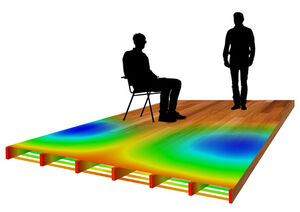
Wooden multi-storey buildings have steadily increased their market share in Sweden since 1994, the year in which their construction was reintroduced after a century-old-ban (due to numerous urban fires during the 1800s) was lifted. Ever since, product development have been carried out based on engineers’ experience and measurements performed in already existing buildings. Nevertheless, complaints amid residents still often arise due to disturbing noise and vibrations. Neighbours walking, jumping, running, playing music or simply talking are common sources of annoyance everyone has sometimes experienced. In this thesis, investigations on how people perceive vibrations were carried out to be able to establish design indicators of human response to floor vibrations. In addition, guidelines on how to create numerical prediction tools to assess the vibroacoustic performance of wooden multi-storey buildings during their design phase were developed.
The regulations currently in force for acoustically approve buildings after their construction were developed for heavy constructions (e.g. concrete) and, despite of their different behaviour, applied directly to lightweight multi-storey buildings after their reintroduction. Due to their light weight and the low energy required to put them into motion, wooden multi-storey buildings are more susceptible to disturbances in the low frequency range (e.g. vibrations caused by impacts of people walking) than heavy constructions and nuisances are often reported by inhabitants of buildings that comply with the aforementioned regulations. Acoustic comfort is, in many cases, not met due to low frequency noise and vibrations, which are left out of the frequency range considered in the standards. Gaining knowledge on how humans perceive vibrations to come up with improvements for the current regulations is therefore needed. Heeding this, psycho-vibratory tests were performed in a laboratory environment with the ultimate aim of develop design indicators of human response to floor vibrations. People were asked to either walk on floors or be seated in a chair placed there as the test leader was walking on it. Measurements of the accelerations and deflections produced were recorded during the whole test. After the tests, the test subjects were given a questionnaire where they described their perception and experiencing of the vibrations. By statistically analysing the objective measurements and the responses obtained in the questionnaires, design indicators of human response to vibrations were developed.
Unlike for concrete buildings, where the vibroacoustic performance can easily be predicted through the use of e.g. computer models during the design phase, prediction tools for wooden multi-storey buildings are still lacking. The variability of a natural material such as wood, the complexity of the junctions between structural parts involved and external factors such as workmanship, makes it difficult to accurately predict vibroacoustic performance. In the thesis, guidelines on how to set up numerical prediction tools are given. The latter was done by calibrating numerical models with measurements performed in a controlled manner. In this way, simplified but accurate prediction tools can be created. Such tools can, during the design phase of the construction, ensure that acoustic comfort is met as well as predict the influence of structural modifications. The development of such prediction tools will entail time and cost savings for the industry, as it avoids the need of building mock-ups and test buildings.